
Praise be to Allah, the Exalted, the Lord of the worlds and blessing and peace be on His slave and Messenger Muhammad ﷺ
About forty-five years ago, just after passing the portal of Madinah university, when I was appointed as an Arabic English translator in the department of call and guidance, Dar-ul- Ifta, Riyadh, I all at once stepped into practical life bidding farewell to academic one, and my acquaintances with those qualified people from India and Pakistan, employed in different ministries and companies of the capital city, Riyadh, began to increase day by day. Many of them, amidst common gossip, would ask me regarding the affairs of call and preaching as to what translation and commentary of the Holy Qur’an was good in Urdu version and what could be more beneficial.
Others, too, would ask the same question about the English translation and the commentary of the Holy Qur’an, rather some others inquired of the senior bodies of Dar-ul-Ifta the same query. They, however, sought the opinion of Maulana Abul A’la Maududi through a letter and he, keeping in view all the translations existing at the moment, replied that Marmaduke Pickthall’s translation in English was the best. By then, the translation and the commentary of the Holy Qur’an in Urdu I was acquainted with, it was an extremely difficult task for me to reply to their questions in the light of those ones. Because in many of those Tafsir books, the basic message of the Holy Qur’an (Monotheism) had not been clearly defined, on the contrary, heresy and deviation from right path had been given currency by some others, while in some of them, the verses of the Holy Qur’an had been interpreted wrongly, avoiding the manner of the Qur’an and Sunnah, in order to spread the astraying and sectarian views and ideologies.
Even by reading the commentaries and explanatory notes prepared by the true followers of the Qur’an and Sunnah, people were not satisfied, because they were incoherent and deficient. The study of those translations could not quench the thirst of the people fond of reading the Divine Book, rather they fell a prey to more complications at so many places.
Consequently, observing the situation, an idea reflected in my mind that such a translation and commentary of the Holy Qur’an in Urdu is necessary as the translator should make it certain that the commentary must follow the essence (core verdict) of the Qur’anic verses, authentic and true Sunnah, statements of the Holy Companions and the explanatory notes reported by them.
In those days, I did not find myself capable of doing this paramount task. Thus, time kept on passing and my sensitivity for the necessity of such a translation and Tafsir increased day by day. In course of time, Allah the Almighty blessed me with a special favour that I grew too much fond of listening to the recitation of the Holy Qur’an. The radio set of my car was fixed to the Qur’an Radio station K.S.A and as I would start my car, my heart and mind would begin to be secured by the echoing sound of the recitation of the verses, while at night, I would switch on my transistor, even I fell asleep but the miraculous melody of the Qur’anic verses would fill up my ears. Thus, listening to the recitation of the Qur’anic verses became my hobby and its miraculous effect kept influencing my soul and sometimes I grew so overawed by the Noble Qur’an that tears would roll down my cheeks recklessly and its impression would spread to the core of my heart and soul.
As I was passing through these experiences, one day an unseen voice called me and through the Mercy of Allah the Almighty it was instilled into my heart that I should perform this extra-ordinary job myself; first and foremost I should prepare a translation and Tafsir of the Qur’an in Urdu version and after publication, when widely appreciated by the people, it should be translated into English and Hindi as well:
So, I started my work invoking the Name of Allah and for this, adopted the same method as has been of the pious predecessors for the compilation of the Tafsir treatises since the very age of the Companions. Ultimately, I wrote the Tafsir of the Qur’an following the true message of the verses, authentic and true Sunnah, true statements of the Companions and explanatory notes reported by them, illustrated the nature of revelation of the verses and sought coherence between them that provides much assistance to understand the facts mentioned before and coming after.
And I focused my attention exclusively on the explanation of the subject of Islamic “Monotheism”. Thus in this context the polytheistic acts, idolatry, grave-worship, the worship of spiritual guides, deviations caused by so-called mysticism, innovation and heresy were refuted as well. At the same time I particularly pointed out even the doctrine of the predecessors regarding the belief of Prophet-hood, seal of Prophet-hood and Attributes and Names of Allah the Almighty. In the light of the Qur’anic verses and authentic and true Sunnah, I have tried to give a clear illustration to all those questions relating to fiqh (Islamic law) which Allah has described in more than four hundred and fifty verses mostly concerning human life. And by the Grace of Allah the Almighty, the required translation and Tafsir was accomplished after five years’ strenuous efforts.
Since I had, however, to adhere strictly to my aforesaid method and manner, I did my job cautiously, especially in the selection of bibliography. Hence, the commentary books that had always been open on my writing desk and which I benefited directly are as follows:
Tafsir-ul-Qur’an-il-Azim by Hafiz Ibn Kathir, Al-Jami-li-Ahkām-il- Qur’an by Imam Qurtubi, Fath-ul-Qadir by Imam Shawkāni, Al-Dhau-ul-Munir by Hafiz Ibn Al-Qayyim, Fath- ul-Bayan by Siddique Hasan, Mahāsin-ut-Tanzi by Allama Jamaluddin Qasmi, Taisīr-ur- Rahınan by Allama ‘Abdur Rahman Al-Sadi and Aisar-ut-Tafasir by Sheikh Abu Bakr Al- Jazairi. Apart from them, I made use of a lot of books written by Sheikh-ul-Islām Imam Ibn Taimiya and by his great disciple Hafiz Ibn Al-Qayyim.
For the translation of the Qur’anic phraseology in Urdu I always put my own Tafsir, Taisir-ur-Rahman before my eyes. Besides the Qur’anic translations of Maulana Muhammad Junagadhi, Sheikh-ul-Islam Sanaullah Amritsari, and Muhaddis ‘Abdul Qadir bin Shah Waliullah Dehlawi were ever present on my table. In addition to these translations, I have taken a great deal of advantage of the Persian translation of Qur’an by Allama Sa’di Shirāzi and Shah Waliullah Dehlawi. While translating, I always kept in my mind that every verse be translated separately, but the translation, however, must be idiomatic and illustrating.
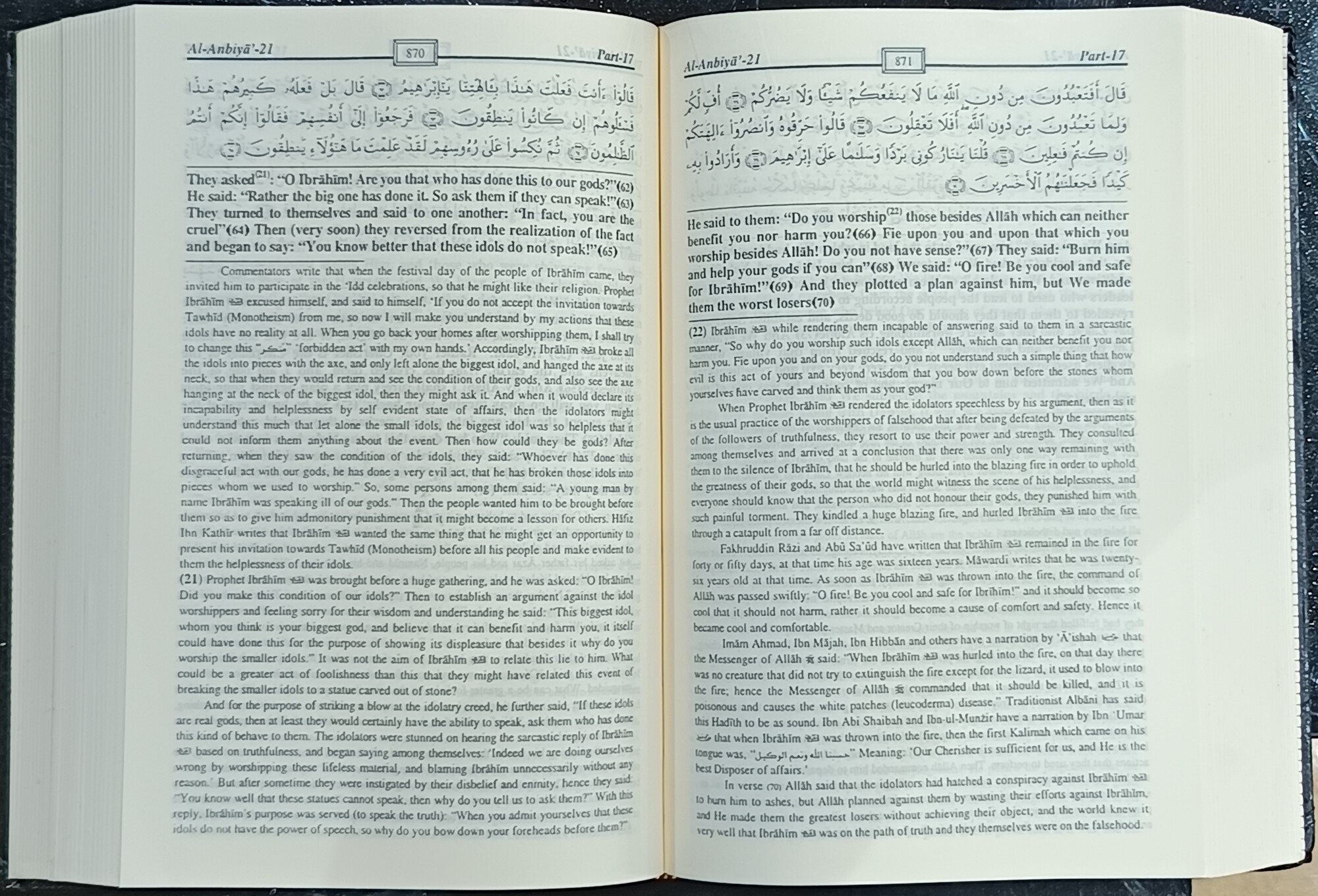
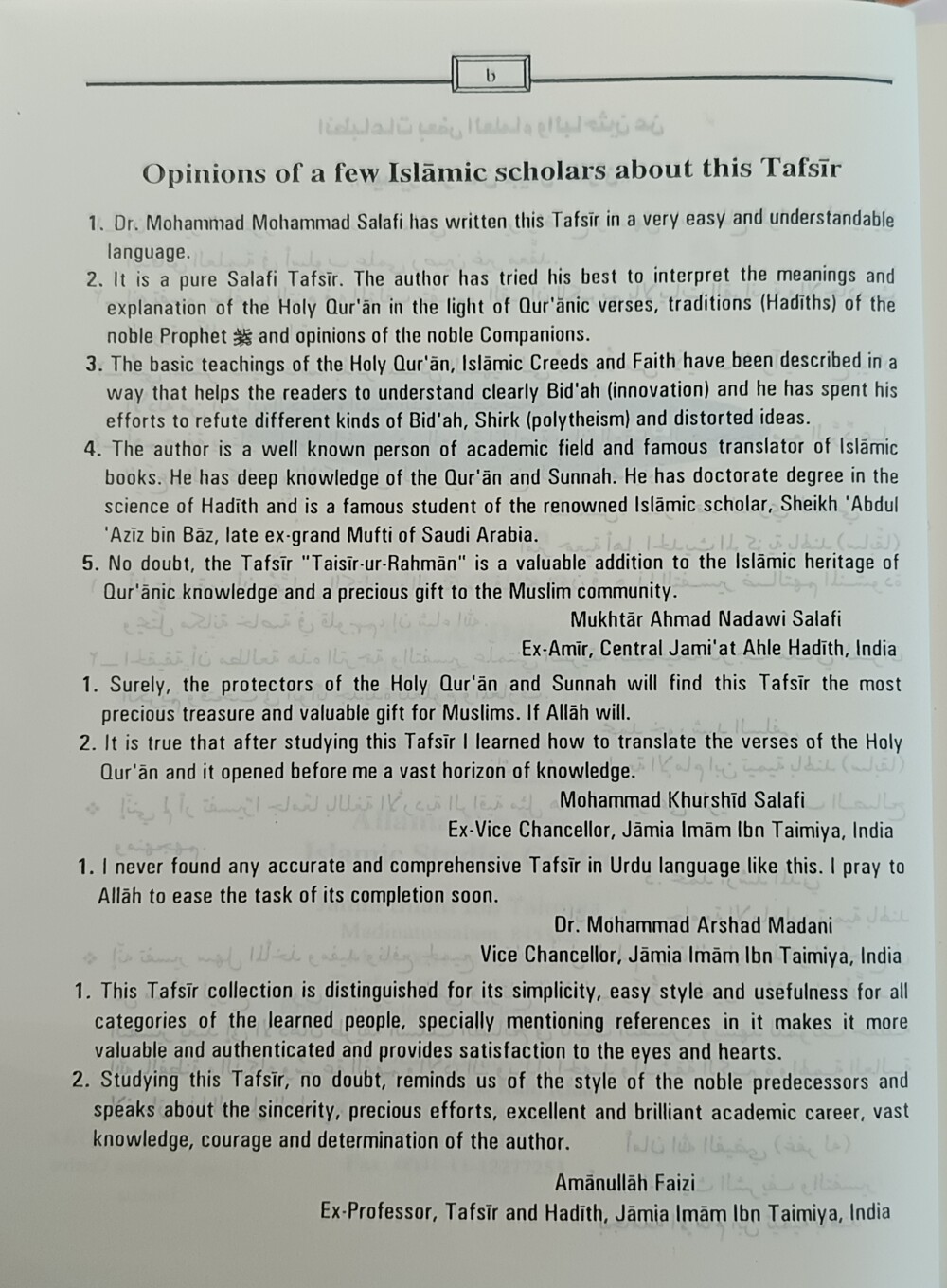
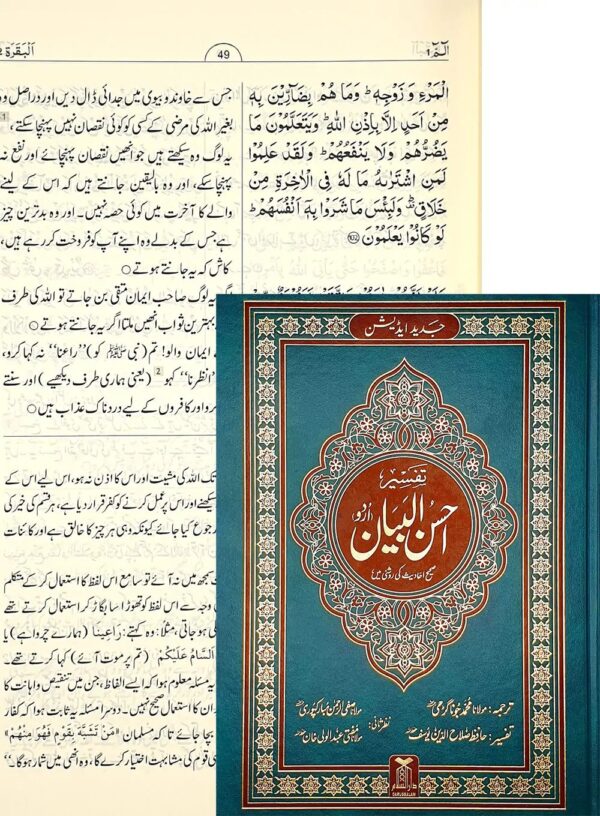
All praises be to Allah! The Urdu translation and Tafsir of the Holy Qur’an, Taisir-ur- Rahman has been published eight times in a very short period, and has gained popularity among the students of Islamic Shari’ah and educated Muslims.
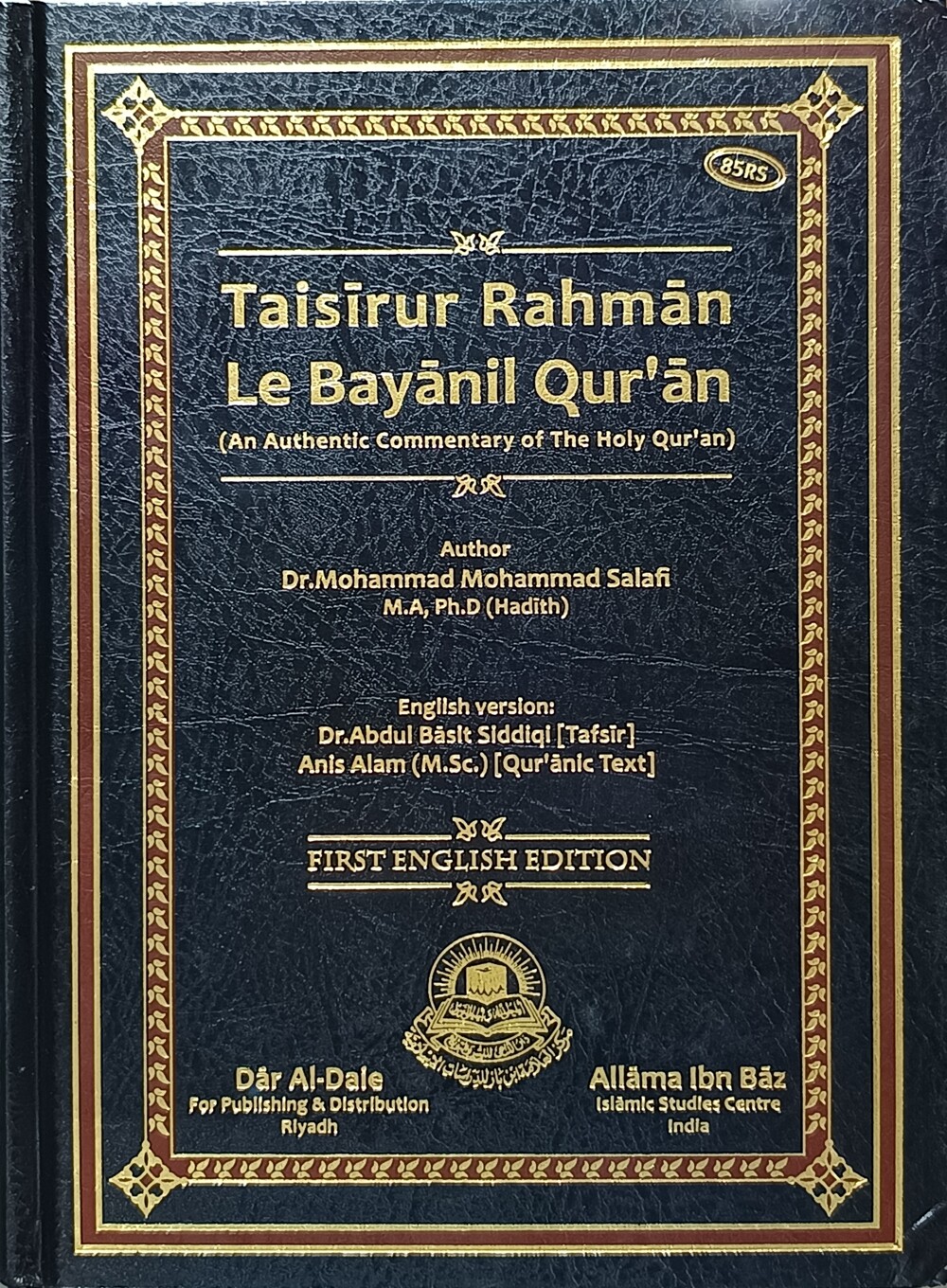
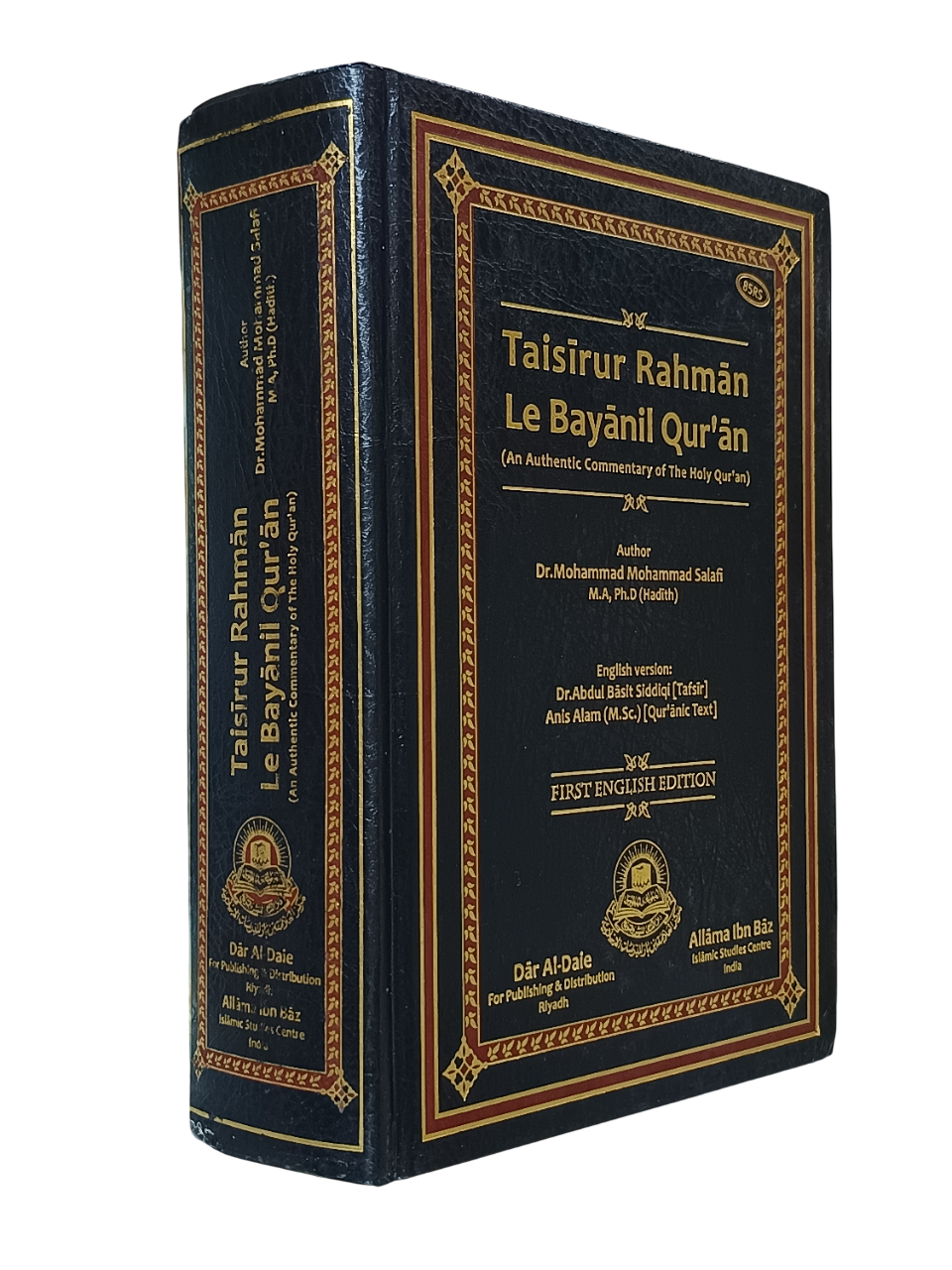
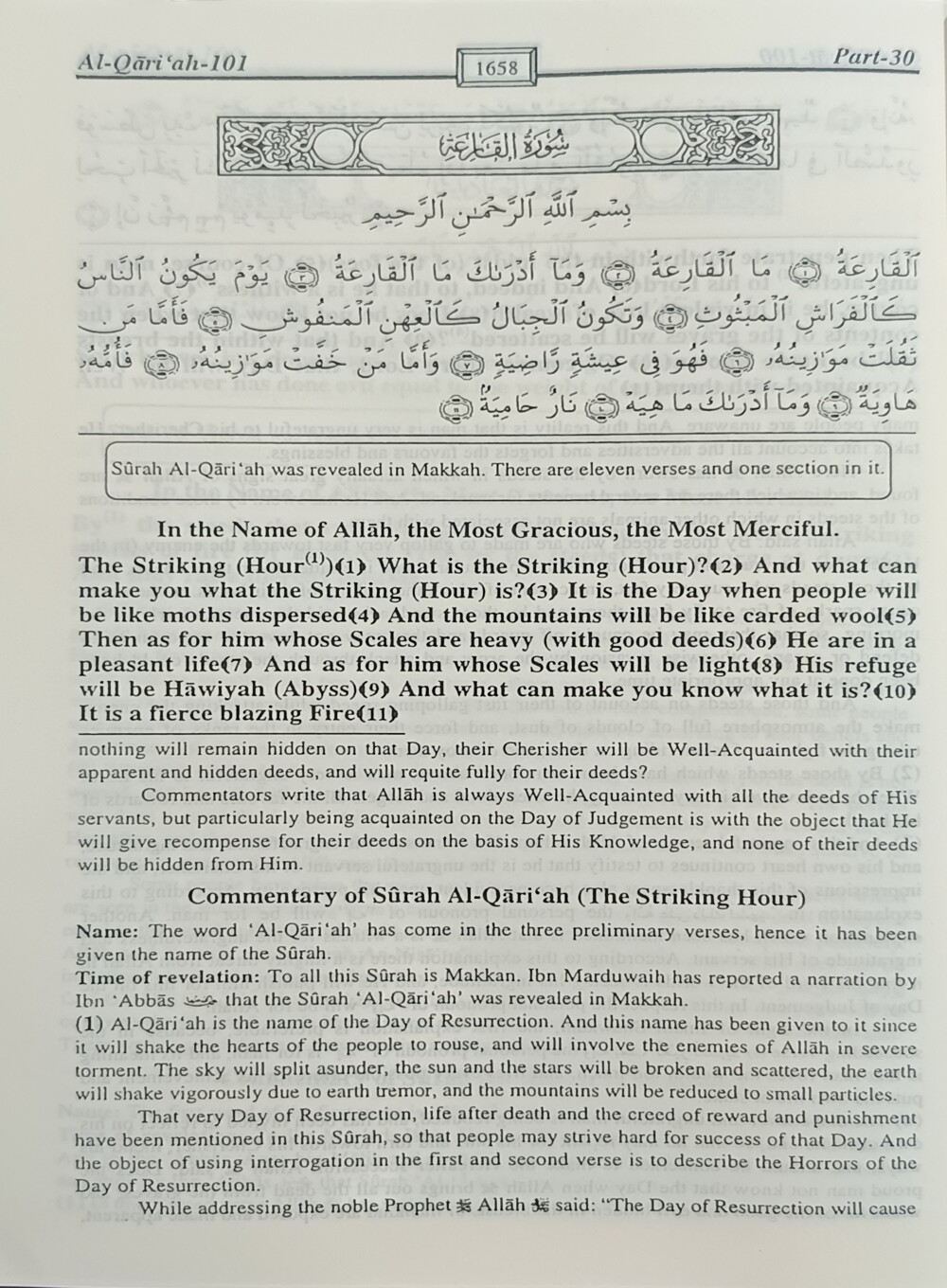
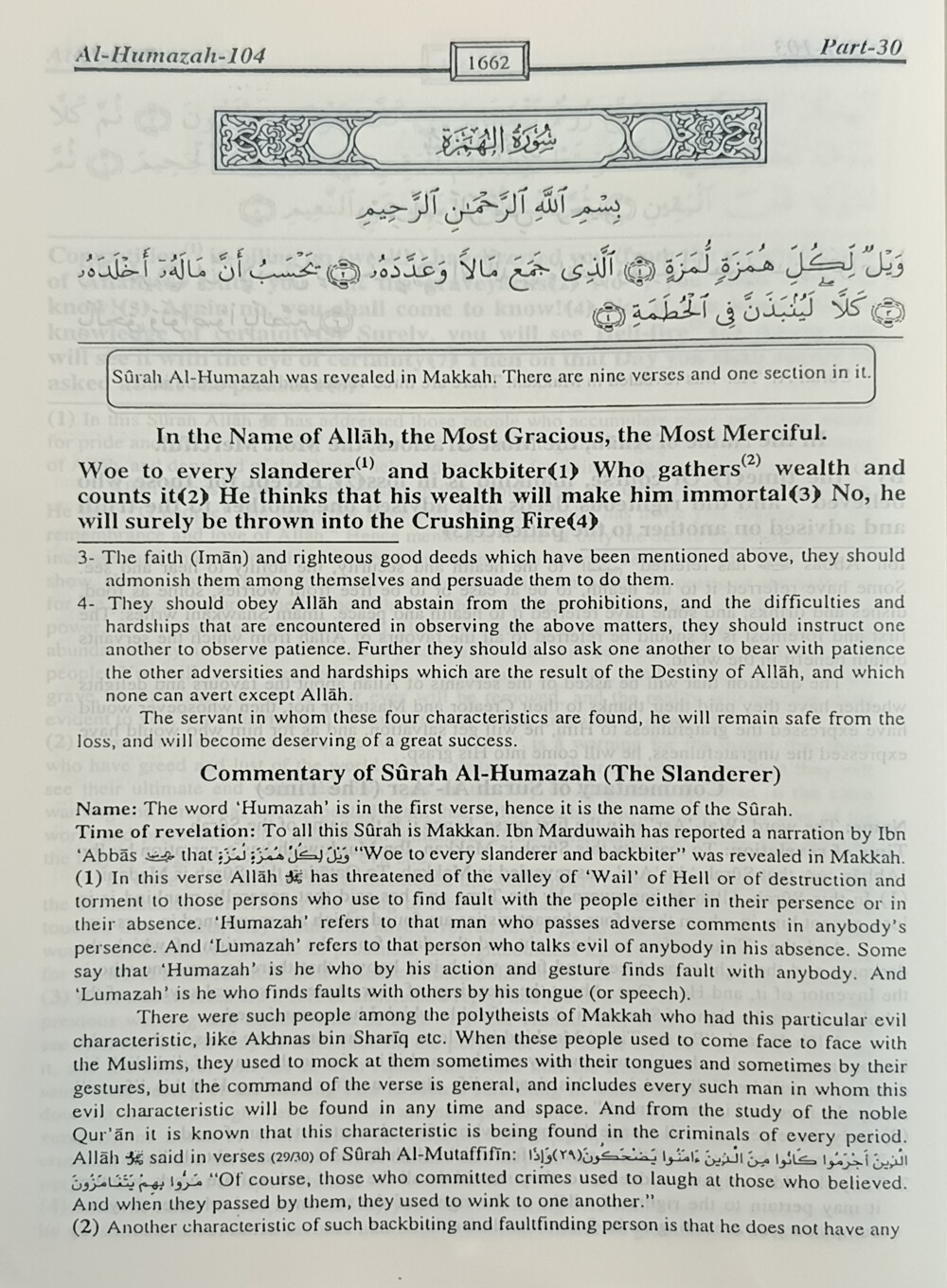
About three years ago, I paid attention to the preparation of its English translation and by Allah’s Grace it is now ready for printing and publishing passing through all stages.
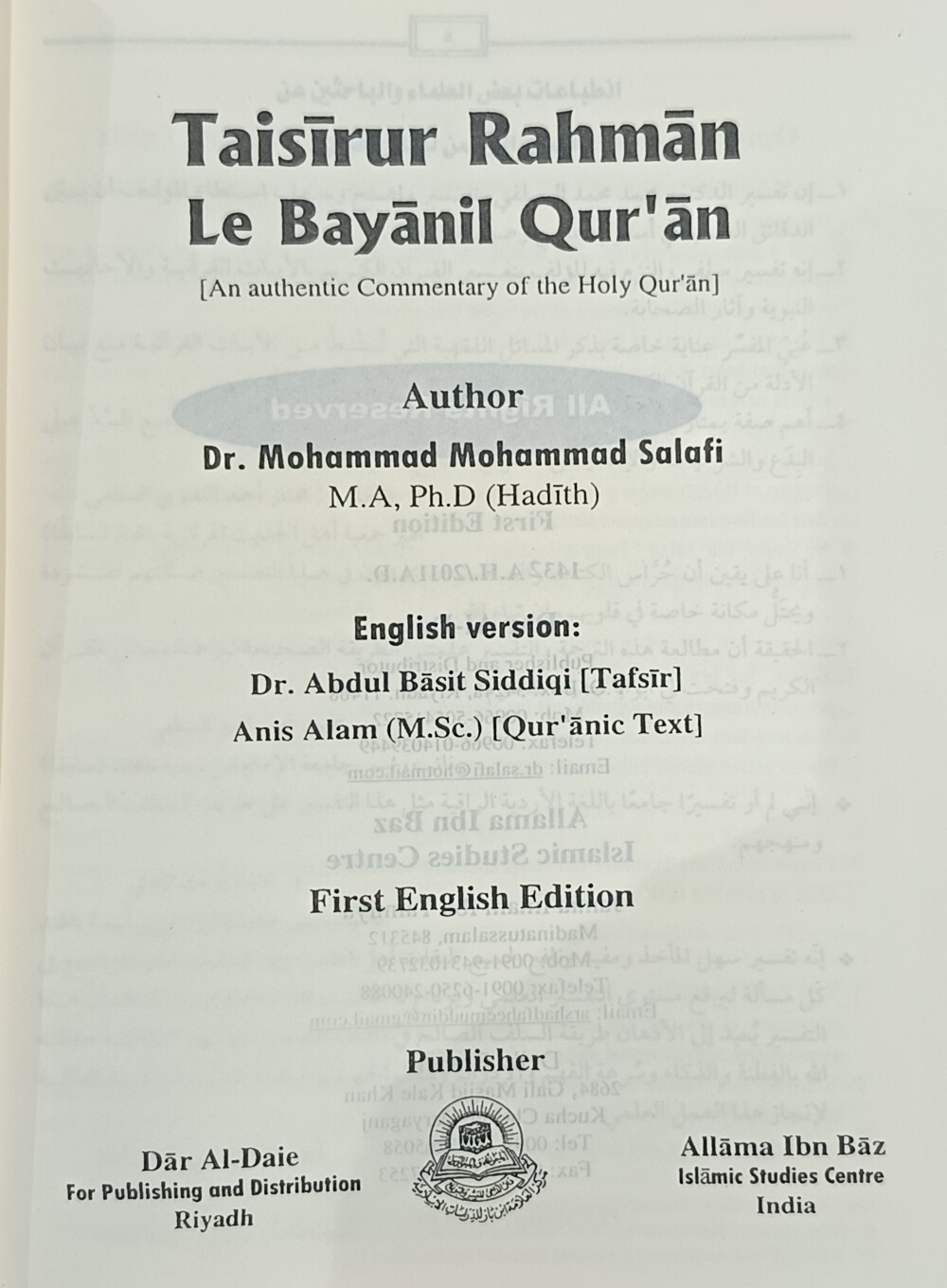
The manuscript of the English version of my Urdu Tafsir was prepared by Dr. ‘Abdul Basit, a renowned scholar from Hyderabad and the Qur’anic phraseologies were translated by Anis Alam (M.Sc. Botany). Both of them are known as established writers and have a decent aptitude for the study of the Qur’an and Sunnah. Moreover, Allah has endowed them with abysmal passion for service to Islam through the medium of the English.
After the accomplishment of the English translation as well as typing and the revision course by the translator himself, the book was also revised by Dr. ‘Abdul Ghaffar Khan of Bangalore and Shafiul Wara (M.A. English) of Bihar with individual attention and extreme care tracking out the errors in translation and typing for necessary correction.
After the typing of the translation of the Qur’änic phraseology and the revision work, I myself along with Anis Alam, the young scholar, restudied it going through each and every letter, and made necessary changes in many places.
The mistakes made by the former translators of the Qur’ānic phraseology owing to their inadequate knowledge of Arabic language, I tried my best to remove all the inaccuracies from this fresh one of mine and I hope that the present translation of the Qur’ān has become much more better than other existing English ones.
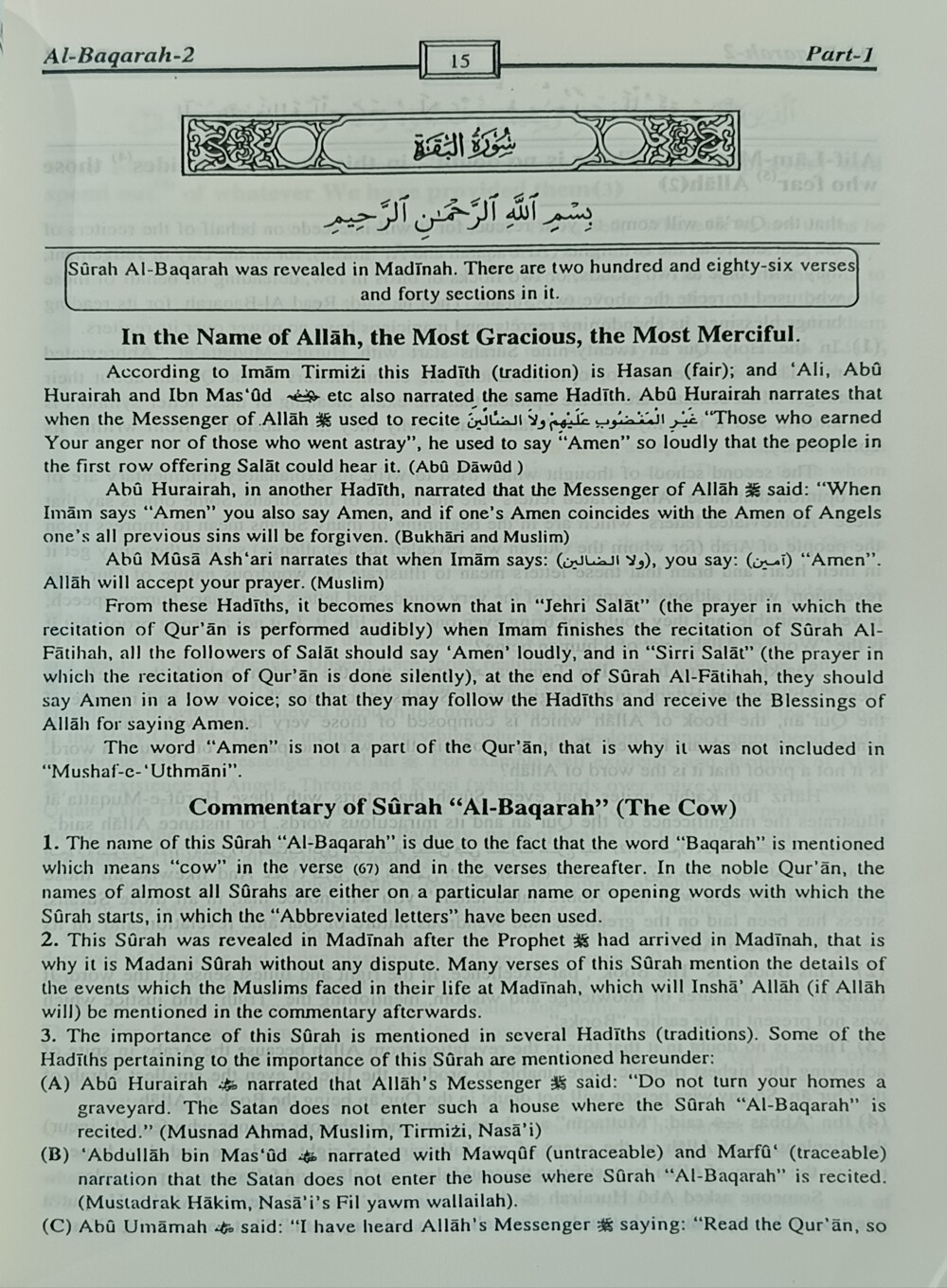
At the time of translating the Qur’änic phraseology and Tafsīr, the English version of Marmāduke Pickthäll, ‘Abdulläh Yusuf ‘Ali, Dr. Muhsin Khãn, and the one of Sahīh International had ever been before both the translators and we the four revision makers in order that they might be amply utilized in selection of appropriate terminology and the setting of sentences.
Thus making use of whatever may be possible for human capacity and capability, we have prepared this English version of the Qur’ānic phraseology and the commentary of Taisīr-ur-Rahmān. I am hopeful that we, the faithful custodians of the Holy Qur’ān, have succeeded to a great extent in preparing an extremely useful English translation and Tafsĩr for all the Muslims and the non-Muslims.
But I am well aware that to err is human and no work done by man is perfect. There is possibility of defect in each of his works. So, we pray, may Allāh forgive our mistakes and bless us to correct the errors marked by any reader.
Dear readers! I now present you this English translation of the Qurān and the Tafsīr (Taisīr-ur-Rahmān) as a sacred offering for your benefit, as thousands of our Urdu knowing brothers and sisters, dwelling in different parts of the world, have been benefiting themselves from the Urdu translation of the Qur’ān and its Tafsir, and they had been soliciting me that I should get an English translation of this Tafsīr equipped with the ornaments of printing for the English knowing brethren, as soon as possible.
It is now my earnest invocation to Alläh the Almighty, may He accept my humble efforts made with a sincere sentiment to serve the Holy Qur’ān. I am also deeply indebted to my wifc (Umm ‘Abdullah) who has been intensely co-operating me in all my scholarly works in general and in preparing the existing translation and Tafsīr in particular.
May Allãh grant popularity to this magnificent work of Islām done by me, the translators, the proof readers and my beloved brother Shafiul Wara who did his best in composing this translation of the Qur’ān and its noble Tafsir. And may He bless the Muslims with His favour to make use of it till the Last Day.
(Dr.) Mohammad Mohammad Salafi (M.A. Ph.D., Hadith)
Ex. Chief Researcher
Dār-ul-Ifta, Riyadh, Saudi Arabia
Dated: 29. 12. 1430
16.12.2009

Reviews
There are no reviews yet.